Showing posts with label household. Show all posts

The Spurtopia Cottage

We had to move out of our rented place in inner city Brisbane. Our very good friends who are like our “Australian parents”, offered us the opportunity to live temporarily with them on an acreage close to Jimboomba until we find a new home to buy.
So “the deal” is we can live in a shed for free in exchange for some help on their property. This, to us, sounds like a pretty good deal, doesn’t it? There are so many people who own a property with a lot of space but do not have the time or strength to look after it, while there are many people who are young, willing to work and have time in their hands. So combined together it is a win - win situation and everyone benefits.
Our intention is to prove the case and show it is possible to achieve, also that converting a shed into a liveable shed does not need to be expensive. The existing shed (6m x 6m) comprises of concrete floor, three windows, an entrance door and a roller door. It is connected to the electricity supply and a rainwater tank with a water outlet on a corner of the shed.
The majority of the materials we used for the conversion are reused, recycled, donated or unwanted items such as:


  •  Kitchenette comprising of a bench, a sink, tap ware and cupboards is a “throw away” from a private hospital
  • Large (2.1m x 2.4m) glazed sliding doors with a crim-safe screen and a kitchen oven from a kerbside collection
  • Wall and roof insulation from the manufacturer off cuts (30cm wide off cut rolls 24m long) about 120 square metres.
  • Camping compostable toilet and gas cooker are donated by our friends
  • Brand new hand basin, tap ware and laminated floor as leftovers from a construction site
  • Plywood wall boards and flyscreens are reused
  • Shower cubical in exchange for a couple of jars of our honey
  • Wooden stove in exchange for three bottles of our home brew mead
  • Recycled garden and swimming pool hose
  • Some minor materials used from the property


So all we had to buy were a few metres of pine studs, plaster board, reflective foil, a sliding door rail, a tiny instantaneous hot water heater and some screws.

First, we insulated the walls with 6cm of thermal insulation and lined with plywood. The kitchen was reassembled and cupboards used as an L - shaped partition to create the bathroom. There are pine studs, a ceiling grill was fitted with two layers of thermal insulations and a reflective foil then lined with plaster boards to create a flat insulated ceiling. The existing roller door was dismantled and replaced with sliding doors which provide a great view at greenery and connectivity with nature. Finally, the plumbing of the existing water supply outlet at the corner of the shed is connected to our shower, kitchen sink, washing machine and an instantaneous hot water heater via a recycled garden hose. Drainage of these outlets is done by reused swimming pool hose.

So now our “Cottage” is spacious open plan space with plenty of daylight, functional, fully liveable, and sustainable, using a minimum amount of rain water and electricity. We collect grey water to irrigate the garden and using the compostable toilet (without chemicals) to fertilize the soil before planting trees.

We look after the existing veggie garden comprising of two shade houses, which produce herbs, greens and veggies which we share with our friends who live here. The existing fruit trees bear a lot of fruit. Our compost heap, which we moved from the old place, became a productive food source with self-seeded tomatoes, thorny cucumbers and other volunteer plants. Lately we built three water efficient, self-watering bath tubs and styro-boxes to extend our growing space. We are also, looking after 7 chickens, of which 3 girls moved with us, laying an abundance of fresh eggs. We keep our bees in our friend’s place in Mitchelton as they are more productive in the city, just recently we harvested over 100kg of honey from two beehives.

The entire conversion of a workshop shed into a “cottage” was done within a couple of months while living there. It cost us less than $600. Our ongoing expense is less than $1 per day for electricity and internet access.

This is a prime example of sustainable existence, where we help each other. It costs nothing extra and there is no need to waste resources, money, time and effort to sustain a family while living a wholesome, frugal and fulfilling life.

Your Spurtopians

SAUERKRAUT – Delicious & Healthy Fermented food

Sauerkraut
Fermented food is regarded as extremely healthy, loaded with enzymes, vitamins and probiotics which are so beneficial for our gut and health. The gut bacteria influence not only our health but also our mood. There is an analogy between the bacteria in soil and the health of plants and the bacteria in the human body and our health. Bacteria and microorganisms living in soil and along roots of plants (on walls of our gut) predigest - making nutrients available to plants (human body). Plants absorb about 2/3 of nutrients through bacteria, so without good bacteria in soil (gut), plants (human body) struggle. While using artificial fertilisers and sprays we are killing bacteria in soil. The same applies to using antibiotics which wipe out all bad and good bacteria in our body which need to be replenished. In soil good bacteria would be replenished with compost, in the human body it would be with fermented food loaded with probiotics (sauerkraut, yoghurt, kombucha etc.)

But did you know that fermented food is very easy to prepare? And if properly stored it will last for several weeks/months. We make great tasting sauerkraut in less than 20 minutes. So how do we prepare it?

Ingredients: 
1 head of cabbage (preferably organic)
2 onions
2 tablespoons of salt (sea salt or Himalayan)
2 tablespoons of caraway seeds
Optional spices (dill, turmeric, ginger... whatever you like)

Process:

- Peel cabbage and onion of outer leaves/skin.
- Cut the head of a cabbage in half with sharp knife and start chopping in thin slices – the thinner the better. The same with onion. (you can use a grater or a food processor)
- Put all ingredients in a large bowl and mix it for a few minutes (use your hands) till cabbage becomes juicy and leave it to rest for a while.
- Load the mix into a large jar (2 or 3 litres glass jars) while constantly pressing cabbage into the jar by hand or with a spoon.
- When it’s nearly full, about 3 cm from the top there should be enough juice to cover the cabbage pieces which is very important. If not, add brine (boiled water with salt at room temperature) to make sure cabbage is completely submerged.
- Clean the rim of the jar and screw a lid on – make sure it’s not tightly screwed as during the fermentation process CO2 gas has to be released from the jar (otherwise you are making a pressure vessel)
- Leave it to ferment at room temperature for at least three days but the longer you leave it to ferment the better tasting sauerkraut you get. The fermentation process is quite dramatic and sometimes it can overflow – so put the fermentation jar on a saucer to prevent a spill.
- Once ready and opened store it in a fridge otherwise it might go off.

We leave our sauerkraut to ferment in a cupboard for a few weeks. One time we left it for a couple of months in summer and it was still fine – self-preserved. If you open it to taste and decide to leave it for a few more days/weeks make sure to use a clean fork for sampling and most importantly everything needs to be submerged in brine when reclosing lid otherwise bacteria can get in and your efforts will be wasted.

In the same way you can prepare a mix of vegetables to ferment such as carrot, beetroot, cucumber, zucchinis, kale, whatever you have surplus of. If using pumpkin, butternut, leave the skin on as it contains beneficial fermentation bacteria. If you want to speed up a fermentation process add a bit of leftover sauerkraut from a previous batch so the process kickstarts faster. Fermentation is an ancient way of preserving garden produce while pre digesting food and enhancing nutritious and biological values ….. and …… we are what we eat.

Happy Fermenting


Living a Simple, Happy and Healthy Life - Article

YOUR VEGIE PATCH magazine in January 2016 issue published an article about our lifestyle. Thank you Tess Holderness for writing such an inspirational story about us and getting our message across.

A worm farm - The vitamin for your garden

A worm farm
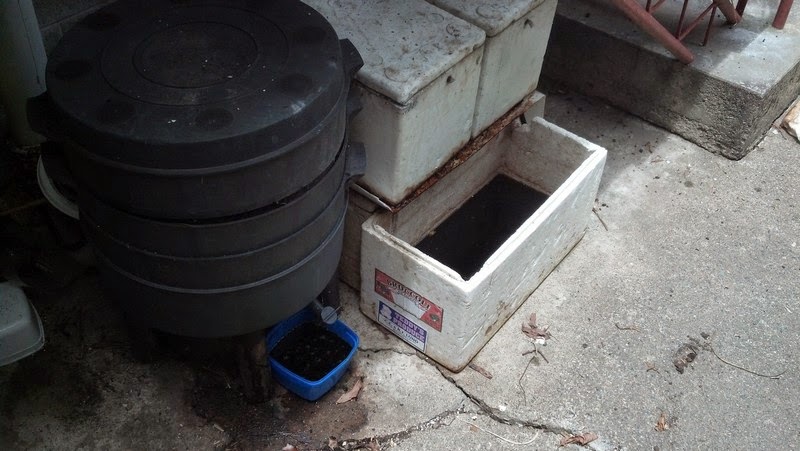
Would you like to convert your fruit and vegetable scraps into rich soil and brilliant organic fertilizer (worm castings) for plants as well as being environmentally friendly? If so, start a worm farm. We have three and they produce surplus of it. Most people would go and buy a black plastic worm farm and worms from a shop but you do not need to do that. We used a styrofoam (broccoli box) with a handful of worms from our friend’s worm farm. We are not only recycling a box (from a local fruit and veggie shop) which would otherwise go to landfill but also it’s all free.

How to make and start a worm farm:
- Get a styrofoam box with a lid and make a hole (with a pencil) in a bottom corner for draining of worm juice and two opposite holes at the upper part of the box for ventilation.
- Place the box on a stand so you can harvest worm juice into a pot under the drain hole.
- To start the worm farm, we put well wetted organic material (shredded cardboard newspaper, leaves or coconut husk (coir) plus a few kitchen scraps and the worms into the box.


Worm farming tips:
Our three worm farms

- Worms do not have teeth so they cannot bite chunky food. They wait until their food is partially decomposed.To speed up the process put kitchen scraps into a food processor and make a mash or place them into a plastic bag in the freezer – as they defrost, they go slimy – it’s ready for the worms to eat.
- Do not over feed worms. Give them food approximately every one to two weeks when they have nearly finished their previous food. If there is too much food, a composting process starts generating heat which might overheat the worms.
- Regularly add shredded newspaper, cardboard or leaves to keep a balance of organic nutrition (kitchen scraps) and carbon (cardboard etc).
Worms - hard workers

- You can add occasionally a bit of diatomaceous earth or fine sand or to help the worms’ digestive system.
- To harvest worm juice (plant fertilizer) water the worm farm with about 5 litres of water once or twice a fortnight or as needed.
- Worms like a dark and moist environment so put a hessian (potato) bag over them. After a while the hessian will also decompose.
- The number of worms depends on the amount of food available. When food is plentiful worms will reproduce rapidly, with little food, numbers will drop.
- Keep your worm farm in a shaded spot so the sun does not overheat it in summer.
- We found a styrofoam box worm farm works better than a black plastic one as styrofoam insulates; keeps worms warm in winter and cool in summer times.
Worm Juice - gold garden fertilizer

- Sometimes maggots appear in a worm farm. There is nothing wrong with that. They help with converting organic materials into rich soil.
- If a lot of worms are on the inside of the lid, it’s a sign of overfeeding or their environment has become acidic. Stop feeding them for a week or so and sprinkle a bit of dolomite on the top.
- If you want to harvest rich soil from a worm farm always take it from the bottom where there’s the most manure. To find any worms which are left in the soil, put it in a pile in the daylight /sun. Worms do not like light and will move towards the centre of the pile. A bit at a time, remove the outside layer of the soil pile. You will be left with mostly worms in the last bit of soil which can go back into the worm farm.
- Food which worms like: fruit and veggie scraps, tea bags and coffee grounds (they absolutely love them) cow, horse, sheep manures, mushroom compost etc. Avoid garlic, onions and citrus peels, meat and bread.
- The bigger the variety of foods you put into your worm farm, the richer the fertilizer and soil you get out of it!
- Worm farm worms are different from those in the ground. They are very efficient at converting their food into worm casting and they would not survive in the ground.

Hope this information helps to start a worm farm. Check our Easy to make worm farm video. We also run hands-on Worm Farming workshops, so you can make your very own worm farm. For more details and dates check our Events and Workshops.

Happy Worm Farming

How to recycle 100% of household waste?

What is in your bin?
It is not a waste of time talking about WASTE.
Australia is a country of abundance but does that mean we can produce a lot of waste? What is regarded as waste should be seen as a resource. We (SpurTopians) walk and talk the "5R" mantra,
Refuse - Reduce – Reuse - Recycle – Repair.
Here are our tips for what you can do:
  • Refuse - Refuse is first and most important. If going shopping, we refuse a plastic shopping bag. Though it could be made from biodegradable material, it had to be manufactured (usually from plants growing where rainforest was destroyed). Use fabric shopping bags rather than plastic bags.
  • Reduce - Opt for less packaging, loose or bulk produce, shop at farmers' markets
  • Reuse – multiple use (glass jars for home made preserves)
  • Recycle – Recycle should be more or less the last option! Recycling 100% of waste is achievable. In fact it is easy to do so. There would be no need for  a general waste (rubbish) bin. Everything is recyclable - paper, plastic, glass bottles and tins in a recycling bin, organic waste into compost or a worm farm. Soft plastic packaging such as cling foil, bags, and other plastic which is not acceptable in a recycling bin, can be recycled in a special recycling bin in every Coles supermaket and is converted into plastic material for making children's playground equipment.
  • Repair – Fix broken stuff to get longer use out of it or buy stuff which is expected to last longer.
- Give away unwanted stuff – Freecycle – offer stuff for free.
- Use cloth  instead of disposable nappies.
- Purchase products which are made to last.
- Up-cycle - make new use from stuff which others regard as garbage. (a wicking pot made from a milk container and chucks cloth) 


We Spurtopians  have reduced our waste generation to a bare minimum and this waste is virtually 100% recycled. And our redundant general bin we reused as a hot water tank for a  home-made solar hot water system. 

Did you know:
- The average Australian family of four people generates enough rubbish during a year to fill up a three-bedroom house from floor to ceiling.
Australians are the second highest producers of waste, per person, in the world with each of us sending almost 690kg of waste to landfill each year (The United States is the highest waste producer)
- For the average Australian household, over $1000 of food is thrown away each year ($8 billion in Australia)
- A garbage truck running around a few suburbs and collecting rubbish, every week, drives an equivalent distance from Brisbane to Sydney and back.
- 60% of household waste is compostable

Stinging Nettle - Spring Detox

Stinging nettle growing through a styrofoam box
Stinging nettle is considered by many as a weed in gardens. For us, it is a most valuable plant. We grow it, eat it and  use it for medicinal, gardening and other purposes. Especially, in spring, young shoots are full of vital energy and natural goodness readily available to us. So why not use it?
Growing nettle in containers keeps it enclosed. It's so vigorous it will grow through a styrofoam box. It is easy to propagate from seeds or runners.
We drink nettle tea in spring. It is a powerful immune system booster washing away toxins and purifying the system - a spring detox for our body to recover after winter.
Summer tea: stinging nettle, mint and honey. When served chilled, it is a most refreshing drink.
Other uses for stinging nettle:

Medicinal:
Richest edible plant source of iron and chlorophyll.
Rich source of vitamins & minerals.
Nettle tea - Spring Detox
Stimulates circulation.
One of the best blood cleansing and blood building herbs known.
Serotonin in nettle can be a benefit to many people who suffer depression.
A rich source of antioxidants.
Leaves used to make nettle shampoo.
Leaves used to make nettle footbath.
Root used to make nettle tincture.

Culinary:
Smoothie (when processed in blender  it does not sting)
Cooked like spinach and used in soup

Animals:
Good for most animals (if dried). Improves egg production in chickens if mixed with their grain.
Nettle rinse for flea control for dogs.
Garden:
Nettle tea fertilizer - full of nitrogen
Nettle plant tonic. (helps build resistance to heat stress)
Nettle spray – for aphid control.

.....and the list is endless....

Did you know when you are stung by a nettle it reduces the risk of developing rheumatism. Also it is supposedly used as a pain killer.

Aloe Vera – Power Packed Green Gem

Aloe Vera - Power Packed Green Gem
The Aloe Vera plant grows in practically every garden or pot. But do we utilize its full potential? 
Most people use Aloe for skin burns (it is the most effective treatment for burnt skin in the world), scratches or insect irritations. However the plant is believed to be capable of much more. So what do we (SpurTopians) use Aloe Vera for?

Drink it in smoothies. We once used just the clear gel in the leaf but now put the whole leaf along with other fruit and leafy greens and flowers into a blender to make morning smoothies. The clear gel is actually tasteless. The yellow sap right under the green skin is bitter, but does not affect the taste at all, and has a disinfecting quality.
Alternative medicine uses Aloe for all sorts of health ailments - it is good for the health of the digestive system by supporting good bacteria in the intestines and repelling parasites and worms. It reduces blood sugar and cholesterol.

Skin moisturizer. It can be used on dry skin or after shaving. It's also good for skin and nappy rash as well as eczema. It provides healing for sun burn and scald burns and a cooling effect. It also mitigates blisters. 

Toothpaste
Take an Aloe Vera leaf, cut it lengthwise down the middle and scoop out the clear gel which is tasteless. Add bi-carb soda and mix it well. The ratio of Aloe gel to bi-carb soda is approx  3:1. If you want a bit of freshness, add chopped mint leaf into the mixture. You can store it in a fridge for several days.

As Hair shampoo, it is very simple to use. Just scoop out the gel and rub it into the hair like traditional shampoo and then wash it away.

Hope the above has inspired you to use Aloe Vera much more . We are going to write about Aloe Vera cake and garden fertilizer soon, so watch this space.

Did you know that in Egypt, Aloe vera was referred to as "immortality plant" and native Americans referred to it as "Wand of the Heaven." Aloe vera is so powerful, it is used to cure  certain skin cancers and  now there is a lot of research into its use in the AIDS and cancer fight. 
Aloe Vera toothpaste with mint

Organic, fresh, free of chemicals toothpaste


How many planets do you need to support your lifestyle?

We all should aim for One Planet Living
These days people frequently use buzz words like “Climate Change”, “Eco Products”, “Food Miles”, “Energy Efficiency”, “Carbon Offset” etc. but very few of us really understand the true meaning of these terms.
Let’s look at this in a bigger picture. Have you ever thought about what would happen if everyone on Earth lived like us in Australia? The answer would be devastating. If all countries consumed the resources that we Australians do, it would take three Earths to support their lifestyle. Australia has one of the world's largest ecological footprints per capita!
We have been exceeding the Earth's ability to support our lifestyle. Habitats are being destroyed, the soil and waterways are being irreparably degraded. We must get back into balance! And we can.
Each of us can make some simple changes that will add up to a great deal of relief for our increasingly fragile planet.
Would you like to measure your ecological footprint to see how the way you live is impacting the planet and what you can do to reduce it?
You can calculate your ecological footprint. More importantly, by changing inputs you can find out the differences and impacts that we make – the bigger picture.
Our (SpurTopia) ecological footprint is one and half planets. What is yours?

Comparison of different countries. (Australia 3 planets)


10 Top Sustainable Living Tips for Rentals

The majority of Australians live in cities where about 30 per cent of people live in rental properties.
Tenants usually feel restricted in what they can, and mainly cannot, do. Why should they be bothered to adapt their home to be more sustainable, if they eventually have to move on to another property?
Does renting mean that they cannot live sustainably? Even if you don’t have a garden or much room, you can still grow herbs or vegetables, for example.
Though we feel like rulers of the Earth, we are actually a most vulnerable species, as we lost the art of simple living and we take most things in our daily lives for granted. What do we do in the event of a power outage or loss of power supply, for example? We don’t consider these things any more.
SpurTopia Residence - Block of 5 unit with a small backyard

Our family have been living in a rental property in New Farm for more than five years. We have adopted a lifestyle of being less reliant on the system and becoming self-sufficient. We do this by growing our own food, using resources readily available to us and using the urban environment to our benefit. As a result, we have also created a more resilient existence.
Sustainable living to us means an enhancement of life, lowering our living expenses and being environmentally aware without compromising our comfort or incurring extra expenditure.
We have created “A Small Kingdom”, where we are living a fulfilling life in complete happiness. Enjoying every moment of life, having a sense of belonging in our community and achievement in our aims encourages us to take further steps into an amazing future ahead of all of us.

We would like to share with you our sustainable-living tips that any tenant can employ to get you inspired to take the first step along this path.

10 top sustainable living tips


Self-watering planter box
1. Grow your own food – in a small garden bed, a pot, even in polystyrene vegetable box. Create your garden on a balcony or a patio. Focus on herbs and lettuce to start with. These are easy to grow and quick to harvest. Start small and then build from there.


Sprouting on a kitchen bench
2. Sproutingsprouts are one of the healthiest, freshest and cheapest superfoods you can eat. You can grow them on a kitchen bench in a jar. In just a couple of days you have great sprouts to eat, while sprouts on the supermarket shelf can be several days old. Mix them with muesli or into fruit salad. Add lemon juice to enhance. The sprouting process significantly enhances vital energy, increases digestible protein, provides vitamins and minerals . Try sprouting mung beans, adzuki, lentils, fenugreek, wheat, barley, rye and alfalfa. Soak seeds overnight, then rinse twice daily in an airy container. Once sprouts mature, they can be stored in a fridge for a couple a days.


Worm farm as a planter pot
3. Recycle organic materials – recycle your organic kitchen scraps, newspaper and cardboard in a worm farm which can be made with a bucket with a lid or a styrofoam vegetable box. This saves organic material clogging up landfills and prevents rotten smells in your normal rubbish bin. As a reward you get a nice earthy compost as a potting mix for pots and a high-nutrition worm juice, an organic fertiliser which plants love.

4. Green Power - purchase 100 per cent green power from your electricity supplier. It doesn’t cost a fortune (extra 5c per kWh), and your power comes from renewable sources of energy.

Rosella Jam
5. Home produce – is healthier and more environmentally friendly, it saves money, is usually better quality and you know what it’s been made of. Think home-baked bread and cakes, preserves, cleaning products using vinegar and bicarbonate soda, aloe vera, for example).

6. Freecycle - give stuff away, get stuff for free from web based Freecycle organisation local to your area. Stuff you no longer want can find a home rather than being dumped to land fill. Or even easier, put unwanted stuff on the footpath with a "free" sign. It usually goes in a day!


Our community BBQ night
7. Functional community - get know your neighbours, swap produce, give stuff away, socialize. It’s fun and provides a sense of belonging in your community.

8. Active transport - walking, cycling and using public transport are better for the environment and your health. Think a car costs about $10,000 a year to run, and a gym membership costs about $600. If you bike, it costs nothing and you don’t need gym membership!

9. Five R's - Refuse-Reduce-Reuse-Recycle-Repair

10. Get out and smash it - do not make excuses and start now. Start with the easiest, smallest thing such as a pot of basil. Do that now and then add more as you go.


Chemical-Free Cockroach Trap


Catch in the trap
Cockroaches living around and in the houses are seen as pests. In SpurTopia we see them as a part of the food chain. They can be a great source of protein for chickens and more importantly the chooks love them. So the question is, rather then spraying surface pesticides in the household (which is not good for human health and environment), why not catch them and feed them to the chooks.
Catching cockroaches in a trap is very easy. Get a glass jar, put a piece of banana skin into it and put oil or Vaseline around the top of the jar. That's it!!! Because cockroaches love banana skins they get into the jar but can not get out as the top is slippery. It works so well. Over one night we caught eight cockroaches and fed them straight to the chooks reducing the cockroach population while improving egg production and nutrition. Trapping avoids the use of nasty chemicals and it's free.

2in1 - Worm farm as a planter pot

2in1 - Worm farm as a planter pot
A worm farm produces worm juice and beautiful rich soil  which is used for growing plants even in pots. So why not combine these two things together.
We made a worm farm as a planter pot.  Use a 10 litre bucket with lid, make 6 holes about 20 mm diameter and 7 cm above the  bottom. Establishing worms in the bucket - use a bit of soaked coir and three handfuls of  soil with worms from an established worm farm. Plant various seedlings and cuttings of Brazilian spinach, strawberries, mushroom plant, any herbs, lettuce or greens of your choice.
Worms love eating fruit and vegie scraps from the kitchen but avoid meal and meat leftovers as they will go mouldy. They love tea bags and coffee grounds. Adding shredded newspaper and cardboard provides carbon. The worms produce liquid which plants drink so you rarely need to water. The "worm farm plant pot" should be kept in the shade close to your kitchen or even hung out of a window, so you can pick greens for your meal and dispose of fruit and vegie scraps.
A hanging worm farm


Plants growing in a worm farm bucket

Home-made Citrus Softener


Thursday 20 Feb 2014


Soaking time
What to do with citrus peels when we eat fruit, chuck them in a bin? No, they are very useful. We use them to prepare citrus softener and add it with each load to a washing machine. Citrus peels contain oil called D-limonene which is a powerful solvent for dirt and especially grease. Also gives washed cloth beautiful citrus scent and freshness. We prepare it as follows:

500 ml plastic container
water
citrus peel

- citrus peels (lemon, orange, grapefruit, lime...)
- place peels into container and cover with water. Soak for 24 hours. The strength of your softener will be determine by the quantity of peels you have in the container.
- strain the liquid and add according to its strength and how "citrusy" you want the clothes to smell. If you need softener for more than one load, several batches may be needed.

Liquid Laundry Detergent


Home made washing detergent
Suitable for top and front loaders
El cheapo -10 litres of laundry liquid cost about $2
Water from the washing machine can be used on a garden

1 1/2 liters water
1 bar of laundry soap OR 1 cup of soap flakes
1/2 cup of Washing Soda
1/2 cup of Borax or Bi-carb soda

- in a saucepan, add water and soap (grated if using soap bar)
- stir over medium heat until soap dissolves
- add washing soda and Borax, stir until thickened then remove from heat
- pour mixture into a 10 litre bucket, then fill the bucket with tap water and stir
- store it in clean 2 litre milk or juice bottles, don't fill to the top as you will need to shake contents before each use
Use approximately 1/4 cup of mixture per load

Related Posts Plugin for WordPress, Blogger...